
Keyz Music Lessons • Learning & Practice
What’s the Best Age to Start Piano Lessons?
By Cobus van der Walt · August 5, 2026
If you’ve ever typed “best age to start piano lessons” into a search bar, you’ve probably found a dozen conflicting answers — 4 years old, 6 years old, “the earlier the better.” It’s easy to walk away feeling like you or your child have already missed some invisible window.
Here’s the truth: there’s a good age to start — several of them, actually — and each comes with its own advantages. What matters far more than the number on a birthday cake is readiness, interest, and the right teaching approach for that stage of life.
Ages 3–5: The Early Starters
Very young children can begin developing musicality — a sense of rhythm, pitch, and listening — well before they’re ready for a traditional lesson format. Methods like Suzuki or “music readiness” classes focus on ear training, singing, and movement rather than reading notation right away.
✔ Pros
Early exposure builds a natural feel for music. Young brains absorb patterns and sound remarkably well.
✘ Cons
Short attention spans and developing fine motor control mean success depends on a patient, play-based teacher and an involved parent.
Ages 6–9: The “Sweet Spot”
This is the age range most piano teachers point to as ideal for starting formal lessons. Kids this age typically have:
- Enough hand strength and coordination to manage the keyboard
- The ability to focus for a full lesson
- Growing literacy skills that transfer well to reading musical notation
- Enough independence to practice with only light supervision
Many pianists who started in this window go on to develop strong technical foundations, simply because they had years of steady, structured practice before adolescence.
Ages 10–12: Plenty of Runway Left
Starting in the tween years is far from “too late.” Older children often learn faster in some respects — they grasp abstract concepts like music theory more quickly, set their own goals, and self-motivate in ways younger kids can’t. What they lose in sheer years of practice time, they often make up for in efficiency.
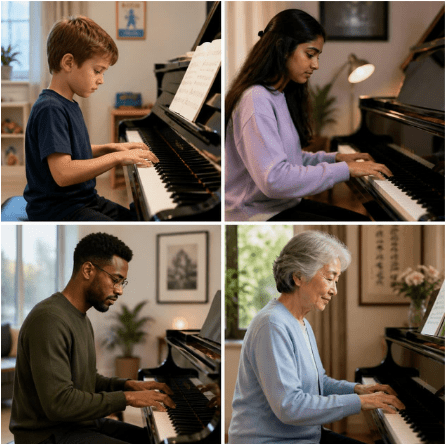
Teens and Adults: Yes, Really
This is the group most likely to assume they’ve missed the boat — and it’s simply not true. Teenagers and adults bring things to piano lessons that young children can’t: intentionality, discipline, and often a genuine emotional pull toward the instrument rather than a parent’s decision.
Adult beginners tend to progress differently than children — sometimes slower in raw finger dexterity, but faster in understanding why something works, since they can engage with theory and structure from day one. Plenty of adults reach a satisfying, enjoyable level of playing within a year or two of consistent practice.
So What Actually Matters?
Instead of chasing an ideal age, it’s more useful to ask:
Is there genuine interest? A child (or adult) who wants to be there will progress faster than one who doesn’t, regardless of age.
Is there a consistent practice routine available? Progress comes from regular, sustained practice — not from starting young.
Is the teacher matching their approach to the student’s stage? A great teacher adjusts pacing, material, and expectations for a 5-year-old, a 10-year-old, and a 40-year-old very differently.
Is there patience for the process? Piano rewards consistency over years, not weeks — this matters more than the starting age ever will.
The Bottom Line
There’s no single correct age to start piano — only different starting points, each with its own strengths. Early starters get a head start on ear training and instinct. Mid-childhood starters often hit a sweet spot of focus and physical readiness. Older kids, teens, and adults bring motivation and cognitive tools that can accelerate learning in different ways.
The best age to start piano lessons is whenever someone is ready and willing to begin.